

“Joe, can you come up to HR? We have an employee issue we’d like to discuss with you.”
That innocuous little sentence in what seemed like an innocuous email from my HR business partner kicked off what would be the worst period of my life. I would be unceremoniously canned from a job I loved, at a company I loved, by people I loved; and would tumble into a black hole of self-pity, resentment, and debilitating depression that would stretch on for nearly two years.
But ultimately the thing I feared the most – a cataclysmic loss of employment, reputation damage, and income loss – became the biggest blessing I could have imagined in my life. It led to immeasurable growth and much-needed change. Lives were literally saved (no, that’s not an exaggeration – more on this later). And I emerged from the other side of this dark period a better person, with a heart that had been necessarily softened. I developed more compassion for the people around me, more respect for my co-workers, and found a better understanding of the character defects that I needed to change.
But it was not a straight line. I made many mistakes along the way. Cried lots of tears. Marinated in resentment. Fantasized about revenge. Behaved like an idiot. Had screaming matches with my higher power. And ultimately turned to drugs to numb the pain.
It was not pretty.
The original email itself wasn’t unusual and didn’t raise any red flags. As the corporate communications leader for a bank based in Tulsa, Okla., I was often asked to be a part of the team when a termination became litigious, or when an executive was caught in an uncompromising situation. The potential for issues of this nature to rise into the awareness of the media–especially in a small town like Tulsa–meant my media relations insight was sometimes needed in HR matters.
In fact, just that week I was made aware of a situation in a small-town branch, where an employee was suspected of stealing from the bank but threatening to go to the media with discrimination claims if she was fired. I figured this was the issue I was being called to HR to discuss.
I made my way up the elevator to the HR Department floor. I was unconcerned.
But when I entered the conference room, I realized something was amiss.
There were two women seated there, neither of whom I knew. One had a notepad and pen. They both had accusatory looks on their faces.
Now my Spidey senses were tingling.
“We have something we’d like to discuss with you,” the more senior attendee–the one without the notepad—stated.
“Did I do something wrong?”
“Have a seat. Let’s talk.”
The conversation didn’t last long. Maybe fifteen minutes. But the accusations were clear. Earlier that year I had chewed out an employee whose severe lapse in judgement had compromised our team’s ability to serve our internal clients.
The employee had accepted a promotion into a vacant leadership role. This in turn led us to hire two recent college graduates to backfill her role and provide additional depth on the team. But days later, she reneged on her acceptance of the promotion, which required her to relocate to the company headquarters. This left us without a leader in a crucial role, but also with two newly hired college graduates who now didn’t really have a place on the team.
In reacting to the employee’s announcement that she would not accept the promotion because she did not want to relocate, I dropped an F bomb. Actually, two.
“You f---ed me over and you f---ed over the entire team!” I said on the phone call.
Weeks later, when the employee asked if her lapse in judgement had ruined her chance for future promotions, I was honest with her. I shared that her decision made me question her ability or desire to lead and that I would not likely consider her for a leadership role in the future.
There’s additional backstory, context, and nuance that supplements my case that my actions didn’t warrant termination, but the bottom line is that my employer decided this was a fireable offense.
The days after the conversation with HR were a blur. I went through all the stages of grief.
At first, as I was leaving the conference room, the “denial” phase was fully evident.
This is no big deal.
I was well respected within the organization by my peers as well as executive leadership. I had proven myself to be a valuable member of the team. I knew our CEO would be disappointed in me, and that I’d have some reputation restoration to do, but there’s no way he’d let me be fired over this. I was too important to the organization, and too visible with investors.
Before I even got back to my desk, I felt anger at the employee. How dare she! I wondered how I was going to continue to work with her on my team, given these events.
Then bargaining. Maybe they’d take away my managerial role. I could live with that. In fact, I was already planning to suggest to my boss that we transition leadership of the corporate communications team to the marketing department so that I could focus on my forte, investor relations, as an individual contributor and subject matter expert. This was in part motivated by some soul-searching and the realization that I was neither good at managing people nor did I enjoy it.
And then, finally, it occurred to me. This event might cost me my job. And that’s when the depression phase of the five stages kicked in, in force.
I felt the waves of a panic attack seize hold of me.
“If I lose my job, I’m completely screwed,” I thought to myself.
First off, I was in no way prepared for a sudden loss of income. I had just spent a significant chunk of my savings on a major home renovation. I had a modest retirement nest egg, but I was still in the process of building it back up on the heels of a costly divorce. And I still had several years of child support in front of me, as well as a requirement to provide healthcare for my youngest child who was still a minor.
I spiraled into catastrophizing. Job loss would leave me in my 50s, unemployed, and with a major black mark on my record as someone who had been terminated for cause. I’d never likely work again – at least not in my field, and not as a senior executive.
The rest of the week was a blur. I tried to read the tea leaves and got very conflicting signals. I called my boss that evening. He acknowledged that he knew HR was going to talk to me “about something” but when I explained the situation to him, he seemed to believe that it was not a big deal. The next day I ran into the head of HR at a company event, and he seemed unconcerned. “You did the right thing by admitting what you did wrong,” he said. “We will get through this.” My teammates seemed oblivious. (I’ll note that the employee in question worked remotely, so I didn’t cross paths with her that week.)
A few days later, on Friday afternoon in a conference room at the end of the hall where I worked, my boss dropped the hammer along with two other representatives from HR.
“We have decided to cut ties with you,” he stated curtly. “HR will tell you what’s next.”
With that, he left the room, and the HR reps did indeed tell me what’s next. And what was next was, I was indeed screwed.
No severance.
I would lose all my unvested equity.
Benefits would end at the end of the month for me and for my family.
And I would be terminated with prejudice and put on the “ineligible for rehire” list. Which essentially meant that any potential employer who checked my employment history would learn this and likely not want to hire me.
With that, I was walked directly to the elevator and I was gone.
I staggered out to my car. I could not think. I could not process the events. But I was sure that my career, and my life, were over.
I sat in the car and pondered my next move.
I contemplated ending it all. I had just the right tool for the job in my glove box.
“Do it.”
“Is this really what it’s come to? Is this really where I end?”
“Do it.”
“I can’t…I’m not strong enough…”
“Do it…”
For a good 10 to 15 minutes I struggled with this decision, trying to work up the courage.
Then my phone buzzed.
It was my daughter, completely unaware of all that was going on, completely unaware that her dad was in crisis at that very moment. I hadn’t even shared with her – or any family members – that my job was at risk. She was texting about a completely different matter.
It was enough. It broke the thought pattern and gave me the courage to hang on for a bit more. I texted my then-girlfriend (now-wife), Holly. She hightailed it to my location, gathered me up, and drove me home. I’ve been in the recovery community since 2001, and three friends from my home group, including my sponsor Josh, met us at my home and helped me get through that dreadful first day and night.
I managed to make it through with their help, but I crawled into bed that night a broken man, full of fear. But alive.
Despite my catastrophizing, I wasn’t out of work for long. One of the first phone calls I made was to a CFO I had met earlier in my career when I was working as an Investor Relations consultant. I had done good work for David and kept in touch with him over the years, and he had just landed a new CFO gig. When I told him what had happened at the bank, his response was immediate: “I’m looking for an IR person!”
David is a turnaround specialist, and the company he went to work for wasn’t in great financial shape. A failed acquisition and subsequent SEC review of its financial statements had put it on the brink of delisting and badly damaged its reputation with Wall Street. The company was highly leveraged and burning cash. But some income was better than no income, and my back was against the wall. I started work two months after the day I lost my job at the bank.
You would think I’d be grateful given I had just dodged a major career bullet and landed on my feet, but as I said at the start of this story, I didn’t do much–if anything–right during this time in my life.
I missed the stability of my previous employer and the status of my job there. It stung my ego to go from a respected multi-billion-dollar financial institution to a small tech company going through a turnaround. And it was doubly difficult to go from pounding the table on behalf of a company I was proud to represent, to being the whipping boy for an angry investor base that had seen their stock go from $50 per share to $6 per share.
The move to New Jersey for the new job was also a culture shock. When I relocated to Tulsa in 2013, I really adapted to life in the Midwest. The mellow pace, the low cost of living, and the kind-hearted people were a breath of fresh air. I had connected with a great circle of friends and just begun a promising relationship with Holly, who would eventually become my wife. Tulsa had become my home. So, I really didn’t relish life in New Jersey with its daily traffic jams, high cost of living, and intense pace of life.
Because of the company’s shaky financial condition, I continued to look for other opportunities. None of them panned out. In my mind’s eye, I convinced myself that my age plus my bad history at the bank made me an undesirable candidate.
I did get close with one opportunity. Not only was the company back in Tulsa, but its headquarters was in the same building as the bank.
The company had advertised on LinkedIn for a Director of External Communications. My diverse communications background combined with some previous consulting work in the company’s industry made me a good candidate for the job. I applied, even though I knew it would be a long shot. The two companies not only shared the same building, but they had common board members (as an example, the CEO of one served on the board of the other, and vice versa). And it was not uncommon for employees to move from one company to the other. Surely, HR would speak to someone at the bank and find out that I had been unceremoniously canned. And that would be that.
So, in our first phone call, I was upfront with the recruiter: “My exit from the bank was not a pleasant one. I lost my temper with an employee, used profanity, and was fired for cause. I want you to know this because if it’s a deal breaker, I don’t want to waste your time.”
The recruiter assured me she was unconcerned but said she would check with the hiring manager to make sure they wanted to go forward. A few days later she called me back and confirmed that I was still a candidate for the job, and they wanted to have me fly back to Tulsa for face-to-face interviews.
Back in Tulsa a few days later, I stayed at Holly’s house, and the morning of the interview I was on edge. The usual nervousness in advance of a big interview was heightened, as I was very concerned about running into anyone from the bank while I was in the building. It didn’t help that I spilled my first sip of morning coffee on my shirt during our drive to the office, and we had to turn around and go back so I could change!
Even with this, I arrived twenty minutes early and checked in at security. The security guard validated my ID, found my host in the building directory, and asked me to have a seat in the adjacent waiting area. Nothing seemed amiss.
As I sat in the waiting area, I noticed a well-dressed man hovering nearby. He looked vaguely familiar, and the thought crossed my mind that I may have met him during my tenure at the bank. I didn’t think anything of it. I nervously reviewed my interview notes while I waited, while keeping one eye on the elevator bank for my host.
Five minutes before my interview was to begin, I saw the recruiter exit the elevator bank and walk towards me. She smiled as she approached, extended her right hand for a handshake, and greeted me warmly.
We chatted for a moment about my trip to Tulsa and the weather. Suddenly, I heard a voice behind me.
“Joe? Are you Joe Crivelli?”
I turned to find the well-dressed man I noticed earlier. The first thought that crossed my mind was that he in fact was a former colleague from the bank and wanted to say hello.
“Yes?” I answered.
“I’m from the security department of the bank. We have you on a watch list. I’m sorry but we can’t let you enter the building.”
And with that my heart sank. This opportunity was shot. There was no way they’d hire me now, knowing that I was on a “watch list”. Blood rushed to my head, and I could hear my heart pounding in my ears. I felt dizzy and confused. I didn’t know what to do next.
To her credit, the recruiter stood up for me and got into it with the security guy. I don’t remember what she said, but it was essentially: “Joe has a legitimate business reason for being here, he’s interviewing with us, and we own the building – you can’t tell us who we can or can’t have here.”
Somehow, they worked it out.
As she escorted me to the conference room where my interviews would take place, she was visibly angry. I asked her if this meant my opportunity was over, and she emphatically stated that this in no way reflected badly on me.
I regained my composure, and the series of interviews in the conference room went well. The hiring manager gave me good vibes and seemed to imply that I was the lead candidate. I left the building that day feeling stung by the bank’s gamesmanship, but also proud of how I recovered from the initial shock and got through my interviews.
The following Monday, the recruiter emailed me:
I hope you had a good trip home. As we are looking at next steps, I didn’t get a chance to talk with you on Thursday about what is important to you regarding benefits, compensation, PTO, etc. to consider making a move to our company. If you don’t mind providing me with that information (generally or more specific), that would be great. If you’d like to discuss I can also give you a call today or tomorrow.
That was a good sign. It seemed like things might be moving in the right direction!
A day later, the hiring manager responded to my thank you email:
I enjoyed our conversation and the opportunity to get to know you! I know we’ve been in touch, and we are working to put an offer together and hope to have something to share with you soon.
Over the next few days, the recruiter and I went back and forth on compensation details, and she assured me that an offer letter would be forthcoming.
Holly and I were excited. I’d be moving back to Tulsa. I’d be working at a solid company again and wouldn’t have to worry about my employer running out of money. I’d be in a director role, which was a big deal at that company. We could move in together and start planning our new life together, and maybe even begin planning a wedding.
Likewise, my friends in Tulsa were excited. My recovery sponsor Josh was quick to point out that, for all my catastrophizing and self-pity and resentment, God still had my back.
“Josh, I just can’t believe that God wanted me to go through all of that, and move to New Jersey, only to land me back in Tulsa, at a company a few floors up in the same building as the bank.”
He assured me that God had a reason for doing the things he did, and that I just needed to accept them. And with the soon-to-be-arriving job offer and the prospect of landing on my feet through it all, I could finally accept that Josh was right.
But the week came and went without an offer. And the recruiter suddenly got quiet and became less responsive.
The following week, I checked in, and she was noncommittal:
Sorry for my delay in responding as I’ve been in a meeting all day. I am still hoping to have something to you mid-week. The company is announcing our org structures this week to employee groups so I am hoping that doesn’t delay me getting information to you. I will keep you posted but I requested an update on timing. Have a good evening.
Another week went by with nothing from the company. It was clear this opportunity had gone sideways. I checked in one more time, and her response was even more cryptic and noncommittal:
I am still waiting on an update. I’m sorry about this. Also, I leave on vacation Tuesday morning and will be out of the country so if I don’t have an update by Monday afternoon, my peer Melissa will be my back up while I am out and I will connect her with you. Have a good weekend.
Predictably, Melissa called the following week and told me that they had delayed filling the position. She blamed the internal restructuring, and said they’d be revisiting the entire structure of the communications department, and that they would be back in touch when they were ready to move forward. But I could tell this was just platitudes.
Later that evening, back at home, I stood at a crossroads. All the pain from my failure at the bank merged with emotional whipsaw from the past month’s experience. I was in intense emotional anguish.
A range of emotions swept over me.
Deep hatred for the people who had done this to me – “The Ten” (ten people from the bank who I viewed as largely responsible for my termination: 4 teammates, the CFO I reported to, the CEO, the two HR execs who officially terminated me, and the two HR professionals who interviewed me about the incident.)
Intense anger at whoever derailed this job opportunity. I was sure that, since the bank knew I was interviewing for a position there, someone had intervened to send it sideways. What else could explain the sudden detour from “we are preparing an offer for you”?
Raging resentment for my Higher Power, who had allowed all this to happen.
I fell into a morass of self-pity.
I stared in the mirror and despised the man I saw looking back for being so stupid as to allow all of this to happen.
I opened the medicine cabinet and reached for a bottle of Oxycontin.
A year earlier I had suffered a debilitating bout with proctitis and had been prescribed Oxycontin for the intense pain. And I took a few of them but subconsciously or consciously banked the remaining pills in my medicine cabinet.
Without even thinking, I popped one in my mouth and downed it with a handful of water from the sink.
As the drug permeated my system, I felt the relief I was looking for and sank into my couch in a state of blissful oblivion.
Thus, would start one more journey with addiction and recovery. For the next six months, I was spiraling down the rabbit hole with opiates and THC and looking for ways to procure even harder stuff. It was a bad path for someone with my history.
My time with the company in New Jersey lasted a lot longer than I thought it would, even though I was using the last six months I was there. I ended up staying there almost two years. But once Covid hit, costs had to be cut. My boss approached me and asked if I’d be interested in hanging out my shingle as an IR consultant and offered to be my first client. We explored possibilities, but I ultimately decided to go in a different direction.
The different direction was teaching. I had studied education as an undergraduate and thoroughly enjoyed the one year I did teach before I “sold out” and went into the business world and pursued my MBA. I wanted to move back to Tulsa to be with Holly and teaching jobs in the region were plentiful. In fact, in many respects, having a teaching certificate in the Tulsa area guaranteed me at least a little income. Doing the math, I figured if I watched my spending carefully, I could live on my teachers’ salary for ten years and put myself in a position to retire at age 65.
After going through the process of getting my Oklahoma teaching certificate, I secured a job teaching freshman algebra at a Tulsa-area high school and made plans to move in with Holly and get married later in 2020.
There was one problem. I had to pass a drug test. So, it was time again to quit. And if I was going to quit, I was going to have to get honest with all the people in my life.
My first phone call was to Josh. He was understanding and compassionate, and unsurprised as well. It’s axiomatic in recovery that an addict can’t live with deep resentments – and I had been marinating in deep resentment for the past 18 months.
We talked about a plan for getting back on track, and he gave me one critically important piece of counsel.
“Joe,” he said. “You’ve always been diligent about working the steps. But there is one step you’ve always neglected: Step 111. So, I want you to look up the Set Aside Prayer and start saying it every morning when you wake up.
You can find the Set Aside Prayer in various forms on the internet, but I zeroed in on a simpler form of it, and modified it slightly:
God, help me set aside everything I think I know about myself, the Big Book, the meetings, my disease, and you God, so I may have an open mind and a new experience with all these things. Please help me see the truth.
I began doing what Josh told me to do, saying the set aside prayer daily, while doing the other things I needed to do to recover from this most recent relapse: daily meetings (on Zoom, as this was in the throes of COVID) and getting honest with the people in my life, especially Holly, who was incredibly understanding, accepting, and supportive.
My first meeting on day one of this new phase of recovery, I told my brothers in recovery about my relapse, and that to the extent I had been attending meetings for the past six months, I was lying about being sober.
“Thanks for your honesty, Joe,” they said one by one during sharing.
After the third or fourth person said this, I shouted, “DID YOU NOT HEAR ME!? I’VE BEEN LYING TO YOU FOR THE PAST SIX MONTHS!”
They laughed and continued to thank me for my honesty. To this day, it mystifies me!
A few weeks after beginning the daily set aside prayer, I added a period of quiet meditation to my Step 11 routine. Soon, daily prayer and meditation became a habit.
In addition, I was still living with the resentments against “the ten”. Something had to be done about it. Recovery literature could not be clearer on this point:
“It is plain that a life which includes deep resentment leads only to futility and unhappiness. To the precise extent that we permit these, do we squander the hours that might have been worthwhile. But with the alcoholic, whose hope is the maintenance and growth of a spiritual experience, this business of resentment is infinitely grave. We found that it is fatal. For when harboring such feelings we shut ourselves off from the sunlight of the Spirit. The insanity of alcohol returns and we drink again. And with us, to drink is to die.”2
Once again, I turned to the literature of Alcoholics Anonymous. In “Freedom from Bondage”, one of the stories in the latter section of the book, there are specific instructions on how to be rid of a troublesome resentment:
“If you have a resentment you want to be free of, if you will pray for the person or the thing that you resent, you will be free. If you will ask in prayer for everything you want for yourself to be given to them, you will be free. Ask for their health, their prosperity, their happiness, and you will be free. Even when you don’t really want it for them and your prayers are only words and you don’t mean it, go ahead and do it anyway. Do it every day for two weeks, and you will find you have come to mean it and to want it for them, and you will realize that where you used to feel bitterness and resentment and hatred, you now feel compassionate understanding and love.”3
I had used this technique earlier in my career, when my relationship with a boss turned sour. It had gotten to the point where his voice from across the office made the hair on the back of my neck stand up. I realized this was no way to live, so I began to say the Freedom from Bondage prayer daily for this particular boss. Over time, our relationship evolved, and I worked in harmony with him for another five years.
So, I added this to my routine and began to pray for “the Ten”.
The reading from the Big Book says it takes two weeks to be free of the resentment. In my case, it was a bit longer than that. But I remember sitting in the shade in my yard saying my prayers. And on that day, I realized I felt no ill will towards anyone from the bank any longer.
“I think I don’t have to say this prayer anymore,” I thought.
The next thought I had was even more powerful.
“You owe them an amends.”
And I did. I spent just over five years at the bank. I did some of the best work of my career. My reputation grew both internally and externally as someone who was good at their job. I got awards for my work. The company’s stock broke out of its historical ranges and traded to an all-time high.
It all went to my head. I became an arrogant prick. And that’s what got me fired.
This was a major turning point for me, in my recovery, and in my career. And for the first time since my firing, I felt completely at peace with everything that had happened.
My teaching career began in August 2020. The first day of school, as I pulled into the parking lot, parents lined the driveway and parking lot, cheering us, holding signs that said, “HEROES WORK HERE!” and “WELCOME BACK TEACHERS!”. Tears welled up in my eyes. At no point in my business career had anyone called me a hero.
There were a lot of uplifting moments in the brief time I taught. One morning Devon–one of the freshman football stars–was walking into my classroom, and he fist-bumped me as he walked past me and said, “How’s it going, bro?”
That little gesture made me feel like a million bucks. I had arrived! I was one of the bros!
Another football player really tested me the first few days of school. This kid, Christian, was the prototypical jock: a bull-headed offensive lineman with a big mouth, wry smile, and quick wit. He pushed and pushed with his misbehavior, trying to get me to crack. One day we were doing algebra drills, and he loudly exclaimed, “Why are we doing this again? We got the point!”
“Christian,” I replied, “If there was a play that absolutely HAD to work for you to win a big game on Friday night, how many times would coach make you run it in practice?”
“Oh, we’d run it over and over again. Maybe a hundred times!”
“That’s what we’re doing here. We are running these ‘plays’ over and over again so when game time comes and I give you a test on it – you can nail it.”
I saw a look of recognition sweep over Christian’s face. He settled down and paid close attention for the rest of class.
That night when I went home, Holly asked me as she always does: “How was your day?”
My reply: “It was the single most fulfilling day of my career.”
Christian never caused a problem in my class again and became one of my most diligent students.
One more example. One of my students, Tamika, missed the first week of school. When she finally arrived, she explained to me that she had been in jail and was facing more jail time and might not be in school for long.
Despite this, she was a good student. She caught up quickly, did her work, paid attention in class, and seemed to really care about her education.
One day, Tamika asked, “Hey Mr. C – how come you’re so chill and my other teachers are so uptight?”
Again – I felt like a million bucks.
However, my teaching career only lasted six weeks. The CEO of the company in New Jersey recommended that a friend, who was CEO of a company that had just gone public, talk to me. A few weeks later, I had an offer to become his IR exec with a compensation package that was many multiples of my annual teaching salary.
But I really struggled with the decision to leave my fledgling teaching career. I was working harder than I ever had in my life, but I loved it. I could see in students like Devon and Christian and Tamika and many others that I had the potential to make a real difference in their lives. Once again, I talked to Josh.
“Joe,” he said. “You might be the only person in the world who would even think twice about this decision. You can always go back to teaching later.”
So, I made the heartbreaking announcement to my classes that I was on my way back to corporate America. Since then, I worked in my chosen profession – investor relations. None of my fears came true. The termination didn’t haunt me, and I was able to continue my career. And now Holly and I are in a place where we can retire comfortably whenever we decide to do so.
At the start of this story, I mentioned that lives were saved because of my job loss. Let me explain.
In the immediate aftermath of my job loss, I was contemplating drastic action to kill the pain I was feeling. The struggle I described sitting in my car in the bank’s parking lot continued for the next several weeks. If I’m being honest, it really continued for the next 18 months.
Josh was deeply concerned about me. He knew I was catastrophizing and spiraling down a black hole that would lead to a relapse, or worse that I would take the drastic and permanent action I was contemplating. Amid this, he developed a plan to try and change my perspective.
“You think your situation is desperate. It’s not,” he said. “But we are going to show you what true desperation looks like.”
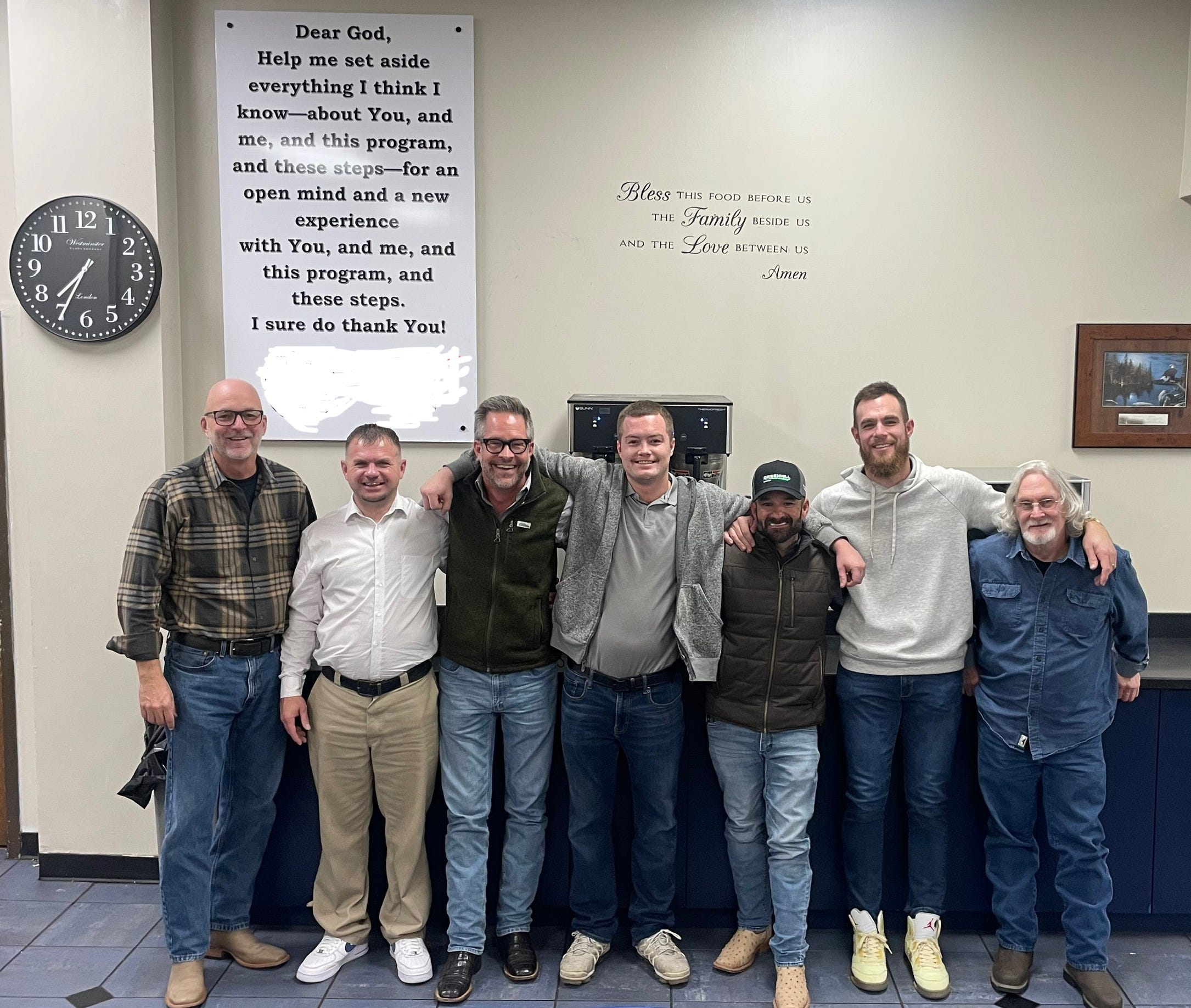
Josh made a call to a local rehab facility in Tulsa to ask if he and I might start meeting with the men who were trying to recover there. He got approval for us to bring a meeting into the facility every other week.
This particular rehab is geared towards low-bottom cases, and the men there largely fall into one of a few buckets:
They had been through multiple rehabs and no longer had the financial resources to go anywhere else.
They were given a tough choice: rehab or jail.
Or they were scraped off the streets and brought in for a shot at a new life.
Seven years later, Josh is still bringing that meeting to facility every Thursday night, and the meetings look more like a tent revival than a recovery meeting. Josh enters the room, often to cheers, and loudly exclaims “How y’all doin’!!!” Week after week, he takes the men through the 12 steps and teaches them how to apply the tools of recovery to live clean and sober.
With his guidance, dozens of men have turned from a life of drinking, using, and living on the streets to one of productive, happy, joyous, and free sobriety.
For example, Cole.
Cole did drugs for the first time when he was 15 years old and, from day one, he couldn’t get enough.
“Drugs destroyed my relationship between me and my parents and my entire family,” Cole said. “I was completely absent from my children’s lives. I grew to hate myself. I’d basically lost everything that I ever loved and pushed away everybody that cared about me until I was completely alone.”
After one last bender in 2021, Cole checked into rehab. On his second day there, he met Josh.
“I didn’t want to go to rehab but I had nowhere else to go,” he said. “But I woke up the next day and felt much better. I’m not sure why. I just had this feeling that I wanted to be there.”
“But the spark that really made me believe that my life could change was Josh,” he continued. “There was just something about him. I’d never met him before, and he came in Thursday night to lead a meeting and there was this glow about him and a spark in his eyes. He shared his story and talked about manufacturing meth, going to prison, being homeless, and it was like he was telling my story. He’d been through the same kind of stuff I’ve been through. And yet he was genuinely happy. And that’s the moment I realized my life could change, too.”
Cole asked Josh to be his sponsor that night. He started working the steps and taking the actions in his life he saw Josh taking. One example: today Cole is a noticeably well-dressed man, always showing up at our meetings looking good in a neatly pressed cowboy shirt, clean jeans, and cowboy boots. One morning at breakfast after the meeting, someone asked him why he always dresses so well.
“Because Josh does,” he said pointedly.
Cole is sober 4 years now, and his life has been completely restored. His children are back in his life, and the pictures he posts on Facebook show happy kids loving on their dad. He’s been employed by the same company since he graduated from rehab – a company Josh helped him connect with. And he’s a pillar of our recovery community, now sponsoring newcomers and taking them through the steps.
“My life has completely changed,” he said. “At a core level I knew I couldn’t have good in my life because of all the stuff that happened in my addiction–burning the bridges down so many times. I just had this belief deep in my soul that I couldn’t ever be good or have anything good. I’m not talking about materialistic things–I’m talking about the peace and joy in my heart, the love of my family, the love of my children, an employer that likes to have me at work. My own place with electricity and water and TV. But the biggest thing that I got back is myself. I believe that I am the person my parents raised me to be, and God created me to be. It’s a continual growth process. I’m nowhere near perfect and that’s OK because it’s progress not perfection.”
And there’s Mason.
Mason was 17 years old when he first started messing with drugs. In short order, he was off and running and addicted to the painkillers that were sweeping America at that time.
A great athlete, at age 18 Mason was drafted by a Major League Baseball club and given a $250,000 signing bonus. Over the next four years he played minor league ball up and down the east coast. At each stop, he found a supply line for his drug of choice: Oxycontin.
“Every place I played, I found painkillers, I smoked weed, I drank a lot, and it led to my health deteriorating,” Mason stated. “I had several elbow surgeries and then got into a fight with one week left in the season. I got hit in the face with a two-by-four and got taken to the hospital. They gave me a morphine drip, and I had to have plastic surgery done on my jaw. Then I got prescribed a bunch of painkillers.”
“The next season I went back to spring training totally messed up and blew out my elbow. I got sent home and cut from the team. That’s when everything really took off.”
For the next 7 years Mason ran the streets of Tulsa with other addicts, including gang members and his girlfriend, a meth-addicted prostitute. With his signing bonus exhausted, the pills he favored cost too much money, so he turned to intravenous use of methamphetamines, heroin, and fentanyl. He estimated he went to jail 17 times during that timeframe for a variety of crimes.
“The last time, I had to sit in jail because nobody would come bond me out. As a result, I was sober for nine days, and that was the longest that I had been sober in my adult life. After those nine days, I called my mom. She told me that she heard her son’s voice on the phone for the first time in years.”
Mason’s mother picked him up from jail and took him straight to rehab. There, he met Josh.
“My second week there I met Josh at a meeting and asked him to be my sponsor. I just knew that’s who I wanted to be my sponsor. I surrendered, and I kept doing everything that he asked me to do. I kept listening, I kept going where he told me to go. I kept trying to help other people.”
Mason is now approaching his four-year sobriety anniversary. He serves as the program director of the rehab where he first met Josh. He’s married to a beautiful, sober woman. And he is a pillar of the recovery community in Tulsa.
“My sobriety is a direct result of my relationship with God and my willingness to work the program. But it’s because of Josh being my sponsor and me being willing to do what he asked me to do and then being willing to help other people.”
And there was Clark. A life-long alcoholic, Clark checked into rehab at age 62 at the behest of his boss.
“I was messed up,” he said. “When my parents passed away, I was drinking way too much. The more I drank, the worse it got. And the worse it got, the more I drank.”
His boss encouraged him to reach out to a rehab where a fellow co-worker had found a solution to his drinking problem. Clark thought, “if it can help him, it can help me.”
Through the fellow co-worker, Clark connected with Mason, who was now serving as intake coordinator for the rehab. At his first meeting, he heard Cole tell his story. Both men encouraged Clark in his sobriety and gave him the help he needed.
Clark is now sober nearly two years and sponsoring other men in the program.
And there’s KP.
KP was abandoned by his parents at an early age and sent to live with his great grandparents and his uncle, a gang member, career criminal, and meth cook. The uncle took KP under his wing and taught him how to cook and use meth – at age 11.
For more than two decades, it was on.
“I spent my whole teenage life in in juvenile detention centers all over the state of Oklahoma,” KP said. “I was a monster everywhere I went, and everything I touched I destroyed. It’s been that way since I started using dope. I turned 18 and started going to real jail but that didn’t slow me down at all.”
“At the end, all I was doing was isolating and shooting up and living in this dark, demonic place. No one wanted me to be around for anything unless they wanted to get high. I hated God and all I knew was chaos and destruction.”
After yet another trip to prison in his mid-30s, KP became suicidal. And with a rope around his neck, he finally surrendered.
“I managed to cut the rope that I had around my neck, and that’s when I finally cried out to God: ‘I’m just done. I can’t do this anymore. I don’t want to die, but I don’t want to continue living like this anymore. Please, either fix me or let me die.’”
A day later, God knocked on KP’s door—in the form of the county sheriff. He was arrested and taken to jail. With his disruptive history, he was immediately placed in solitary confinement and given two books to read: a Bible and the Big Book of Alcoholics Anonymous. Later, he was sentenced to one year in rehab. And that’s where he met Josh.
“In rehab you go to a bunch of meetings, but Josh’s meeting was the best one. It’s the coolest meeting I’ve ever been to, anywhere. I felt comfortable talking about anything that I had on my mind. You can be yourself without holding back anything. I just loved it. That’s where I met Clark, and he got me hooked up with the sober living house where I’m staying now.”
Today KP is approaching his one-year sobriety anniversary, which falls on 11/11 – a reminder of his first meth hit at age 11. He serves as president of his sober living house. He works full-time at a local hotel. And he sponsors other men in recovery.
KP noted, “I don’t believe in coincidences. Everything happens for a reason and God has a plan for us all. I just had to surrender, and God was waiting for me. There was nothing He could do until I finally cried out to Him. And then He reached his hand down and said, ‘Come on, KP, I’ve been waiting for you for a long time.”
KP’s newest sponsee just checked into rehab a month ago: Josh’s own son Mark, who has been drinking and drugging for years.
I’ve known Josh for over a decade and seen firsthand his anguish as his son followed his early path. At times, it seemed that Mark wanted to get sober. He even had six months of sobriety once after a stint in rehab. But within days of his discharge, he was drinking and using drugs again, and within weeks he was living back on the streets.
It’s befuddling to me that a kid who has a father like Josh could continue to struggle and resist sobriety, but that’s what is so confounding about this disease. It doesn’t matter who your parents are. It doesn’t matter how many good influences you have in your life. Once it takes hold, it doesn’t let go until some profound change happens, or you die.
And so, if KP’s sobriety and sponsorship is the profound change that happens for my sponsor’s son Mark, it brings everything that happened full circle.
My job loss set in motion a chain of events. I spiraled into self-pity and depression. A sponsor who loves and cares for me was concerned enough to take drastic action to help me snap out of it. He started a meeting in a rehab facility. He dragged me to that meeting.
All because God had a plan for Cole, and Mason, and Clark, and KP…and now Mark…and many others. God needed Josh in that building to change the course of their lives. And maybe he needed Josh in that building so his own son’s life could be saved.
Humans have tried to make sense of suffering since the beginning of time. And even though mine was self-imposed, God was able to make use of that suffering. In turn, he ended the suffering of many other men who have, “now recovered from a seemingly hopeless state of mind and body”.4
Ultimately, everything I thought I lost when I was fired on September 21, 2018, was restored to me. My greatest fear, the sudden cataclysmic loss of a job, ended up being…nothing. But the greater good that came out of that sad chapter of my life has been priceless.
Sought through prayer and meditation to improve our conscious contact with God.
Excerpt From Alcoholics Anonymous, Fourth Edition. Alcoholics Anonymous World Services, Inc.
Excerpt From Alcoholics Anonymous, Fourth Edition. Alcoholics Anonymous World Services, Inc.
Excerpt From Alcoholics Anonymous, Fourth Edition. Alcoholics Anonymous World Services, Inc.